Who this is for in Ahmedabad
The businesses that need this are not hard to find. Plenty of units in Naroda, Vatva and Odhav run real volume — orders from dealers, production across shifts, stock in a godown — on a phone, a register and one person's memory.
That works until it does not. An order typed into a chat becomes the wrong dispatch. A dealer asks where their material is and three people scroll back through WhatsApp to find out. The owner cannot take a week off, because the whole state of the business lives in their head.
If that sounds familiar and you have somewhere between fifteen and a few hundred people, software built around how your team already works will usually pay for itself quickly. If your process is standard, an off-the-shelf product is cheaper, and we will tell you so in the first conversation.
What we build
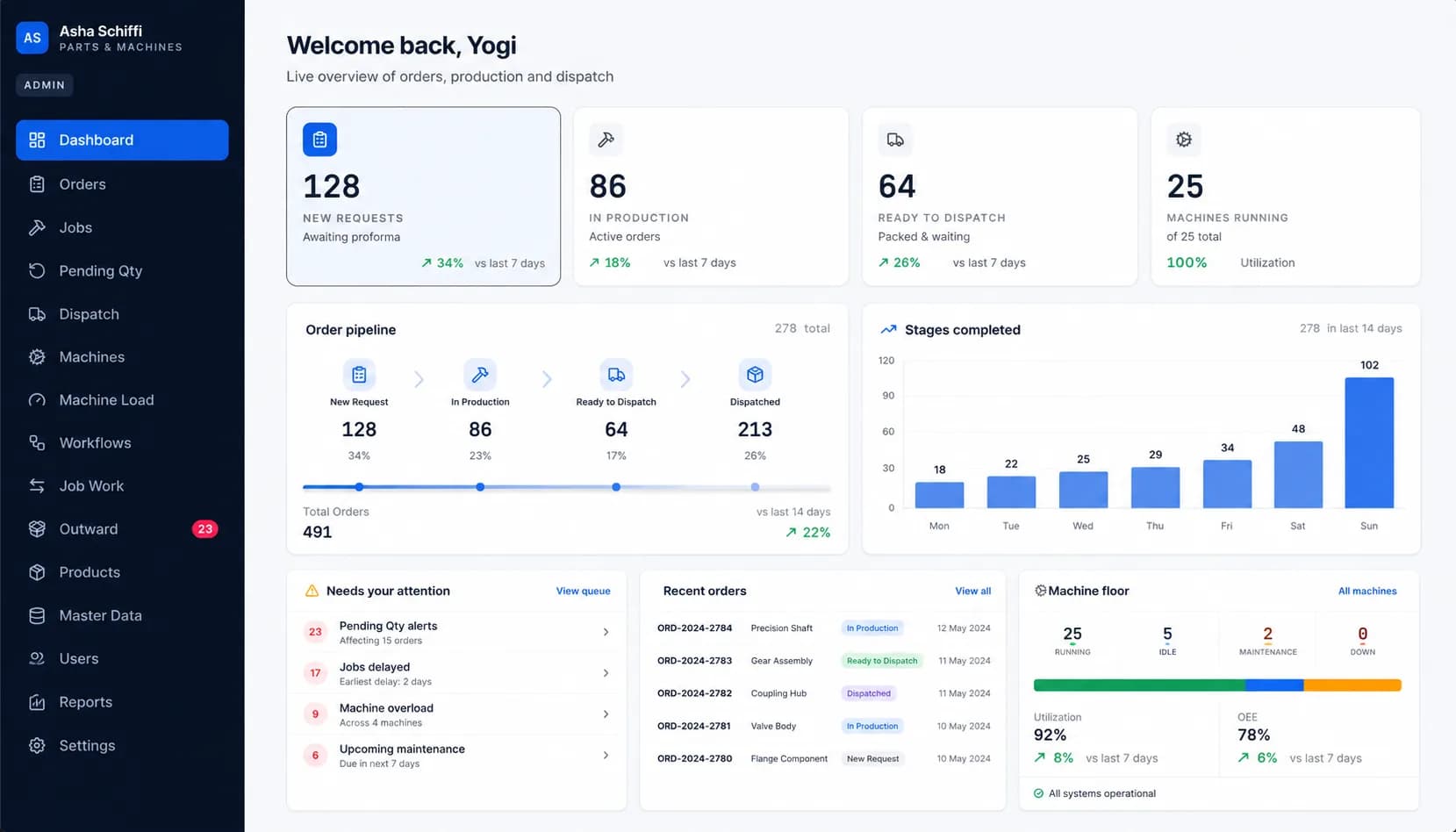
One system of record for the work, with a view for each person who touches it.
- Order portals — dealers and customers place and track orders themselves, by part number, against their own pricing.
- Production tracking — every job moves through visible stages, and delays surface before a customer has to call.
- Stock and inventory — one ledger that sales and the godown both read, instead of two lists that disagree.
- Internal tools — approvals, dispatch planning, reporting that answers the questions the chat threads used to.
- Progressive web apps — installed on the phones your floor staff already carry, working through a weak signal.
How a project runs with an Ahmedabad team
The first deliverable is not code. It is an accurate picture of how the work is done today, including the workarounds, because that is where the real requirements are.
- Discovery — at your office or on the shop floor if you want us there, otherwise on video. In Gujarati, Hindi or English, whichever your team actually speaks at work.
- A system of record — the catalogue or the stock becomes the one place the truth lives, and the order, production run and dispatch hang off it.
- Staged delivery — the first useful piece goes live early, so your team is using it while the rest is built. A focused tool takes six to ten weeks; ordering, production and stock together take three to five months.
- Training at launch — for the people on the floor, in their language, on the devices they will use.
- Support after launch — a named contact and an agreed response time, not a ticket queue.
Where our systems already run
Manufacturing and lighting: an industrial parts exporter with a catalogue in the thousands, a lighting manufacturer whose stock and sales had drifted apart, and a decorative lighting brand selling online. The first of those is walked through below.
Nothing about that problem is specific to lighting. Textiles, engineering, chemicals and trading — the industries Ahmedabad is built on — all run on orders, production and stock, and all hit the same wall when those three have no shared place to live.
The technology, and who owns it
Next.js and React, written in TypeScript, delivered as web applications and progressive web apps. One codebase serves the office desk and the factory floor, with no app store in between.
The code is yours: your repository, your hosting, your credentials, with a written handover. You can take it to another developer whenever you want.